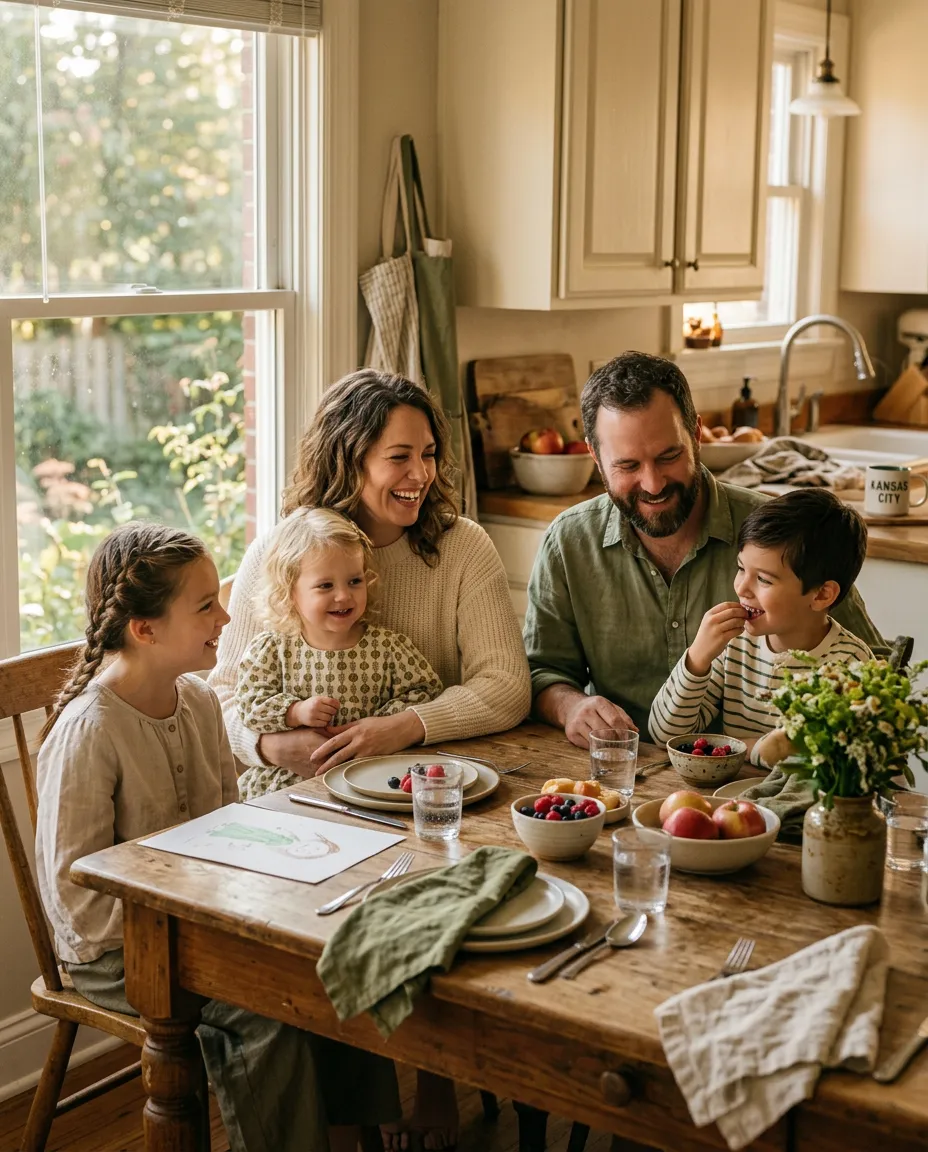
We spend so much time managing family life. But what are we actually building?

The Family Table is an upcoming, practical course that helps you intentionally build a family where everyone belongs, everyone contributes, and children grow up connected, capable, and resilient.

The Family Table asks the questions worth slowing down for:

What do you believe?
What matters in your home?
How do you treat one another?
What does it mean to be part of your family?

And helps you answer them — on purpose.

The course

It gives you practical tools to create a shared family vision, define the values you want to live by, and bring them to life through the routines, rituals, conversations, and responsibilities of everyday life.

So your children grow up knowing:

I belong here.
I have something to contribute here.
I am capable of doing hard things.
And I know what it means to be part of this family.

You’ll receive the free guide, Build a Stronger Family in 10 Minutes, as a thank-you.

The missing piece

No one teaches us how to intentionally build a family.

We learn how to care for children. We learn how to manage meals, appointments, laundry, schoolwork, discipline, screen time, and bedtime.

We read about developmental milestones and search for solutions to whatever challenge is unfolding this week.

But few of us are ever taught how to lead a family:

How to create a shared vision for the life we want to build.
How to name the values that matter most—and make them visible to our children.
How to create rituals that hold us together and responsibilities that help everyone contribute.
How to give children a secure place to belong while also helping them become resilient, responsible, and increasingly independent.

So we do our best. We respond to what is urgent. We keep everyone moving.

And somewhere in all that managing, we can lose sight of what we are actually building.

Why this matters

Children need both a place to belong—and a role to play.

Our children are growing up with more ways to connect—and many are still struggling to feel that they truly belong.

A CDC review of adolescent research found that strong, positive relationships with parents and other caring adults protect young people from a range of poor health outcomes and support healthy development.1 Children benefit from dependable relationships and places where they feel known, supported, and important.

But children need more than the security of knowing they are cared for. They also need opportunities to discover that they are capable.

They build confidence and resilience by contributing to family life, taking age-appropriate responsibility, solving problems, recovering from mistakes, and seeing that what they do matters.

A strong family culture gives children both:
A secure place to belong—and a meaningful role to play.

It tells them:

You are loved here.
You are needed here.
We believe you can do hard things.
And we will help you learn how.

1. Sieving et al., “Youth–Adult Connectedness: A Key Protective Factor for Adolescent Health,” Centers for Disease Control and Prevention, 2017.

Your family already has a culture.

It is being created in the language you use, the behavior you celebrate, the expectations you hold, the work you share, and the way you treat one another when life gets difficult.

It lives in the stories you tell. The traditions you repeat. The way you respond to mistakes. The moments when you step in—and the moments when you let your children try.

The question is not whether your family has a culture.
The question is whether you are creating it on purpose.

Why I created it

Why I created The Family Table

Heather, founder of The Family Table

I spent decades as a teacher and principal, intentionally creating cultures where children experienced belonging, responsibility, and courage.

Then I realized something uncomfortable—and, honestly, a little embarrassing. I had not been nearly as intentional about the culture of my own family.

Of course I loved my family. I thought constantly about what my son needed. I managed the schedules, made the plans, created traditions, and tried to hold everything together.

But I had never stopped to ask:

What are we trying to build together?
What do we want our family to stand for?
What do we hope our son understands about who we are—and what it means to be one of us?
Are we only taking care of him, or are we also helping him see himself as a capable and contributing member of our family?

I knew how to help classrooms and schools answer questions like these. Why had I never been given practical tools to answer them at home?

That question became The Family Table.

Not another set of parenting rules. Not another impossible standard for families to fall short of. A practical approach to deciding what matters most—and building a family life that reflects it.

Because one day, our children won’t remember every rule we made or every first-day-of-school sign we held up.
They’ll remember what it felt like to be part of our family.

The Family Table approach

The course will guide you through four parts

1

Set your vision

Decide what you are building together and what you want it to feel like to belong to your family.

2

Establish your values

Identify the beliefs that will guide how you live, make decisions, face challenges, and treat one another.

3

Anchor them in everyday life

Turn your vision and values into routines, rituals, conversations, and shared responsibilities your family can actually practice.

4

Tend your culture as you grow

Create ways to reflect, repair, celebrate, and adapt through every season of family life.

You do not have to redesign your entire family overnight.
You need a place to begin—and practical tools that help your family build it together.

Tools made for real family life

Not a course you watch and forget.

You’ll receive practical tools you can use with your family, including:

A guided family-vision exercise

Values cards and conversation prompts

Age-appropriate ways to involve children

Routine and ritual planners

A family contribution plan

Tools for creating meaningful household roles

Simple family-meeting guides

Questions that help children work through problems before adults step in

Tools for talking about mistakes, repair, and perseverance

Practical ways to give children greater ownership as they grow

A family culture plan you can return to through different seasons

These tools are being created for real families: busy, imperfect, loving people trying to be more intentional in the middle of ordinary life.

The goal

Build a family where your children belong, contribute, and grow capable.

The goal is not a family where no one struggles. It’s a family where your children know who they are and trust that they can meet what comes next.

A family grounded in connection—but not dependence.
A family that offers both roots and room to grow.
A family whose values are not simply stated, but lived.
Help shape the first Family Table course

Do more than manage family life. Lead it with intention.

I’m building the first Family Table course now, and I’d love your help shaping it. Join the waitlist to be the first to hear when it opens—and to help decide what goes inside.

As a thank-you
Build a Stronger Family in 10 Minutes

One simple conversation to help you pause, reconnect, and begin creating your family culture on purpose.

If it were available, which would you want?Pick any — it helps me shape what to build first.
You’re on the list — welcome to the table.

No perfect family required. Just a willingness to begin. (Connect the email field + the format checkboxes to your email tool so each preference saves as a tag.)